My Love-Hate Relationship With Age of Darkness
The Dark Souls of RTS debuted in Early Access – it's called Age of Darkness: Final Stand. This production made me fall into an abyss of madness and despair. Here's why.
Strategy games are my great love (next to RPGs). It's safe to say I cut my teeth on them. I grew up playing the Age of Empires series, I've spent hundreds (if not thousands) of hours with all installments in the Total War series, and the games from Paradox Interactive have no secrets before me. However, beyond these established, long-running series, I have always tried to seek out interesting productions that have an original idea behind them. When I heard about Age of Darkness: Final Stand, I had no doubt that it was a must-play for me.
After a couple/dozen hours? I've honestly lost count of the hours I've spent with this game, but I can say that it surely is difficult. Very much so. I ended a session tired and feeling cheated by this game more than once. However, I always persistently returned. Each time, I told myself "this time I will defeat the next wave of enemies" and I mostly succeeded. These victories brought me much joy and a sense of accomplishment. I can confidently say that despite early access, the production already has a solid foundation. However, as any souls game, this won't be up everyone's alleys, and it generally requires some more polish.
Courtesy of PlaySide studio, I was able to play Age of Darkness: Final Stand a few days before the early access release, but I suspect that the final version will not be significantly different from the one I tested. This game also recently debuted in early access. For the moment, players can only enjoy the survival mode – the full version is expected to have a story campaign as well.
They Are Darkness
Age of Darkness is a game about developing a settlement and preparing it for subsequent hordes of monsters, whose sole desire is to kill everything alive. If at this point you are having flashbacks from They Are Billions, it is a correct association, because the game is perhaps the biggest inspiration behind PlaySide's work.
We start the game in a typical way – with a single building, which we have to defend at all cost, a few soldiers, and a lot of work to get done. With a band of brave warriors, we explore the map, pushing the creatures of darkness out and expanding the borders of our domain. At the same time, we search for deposits of valuable raw materials, such as stone, iron and gold, which are necessary to create more advanced buildings and units.
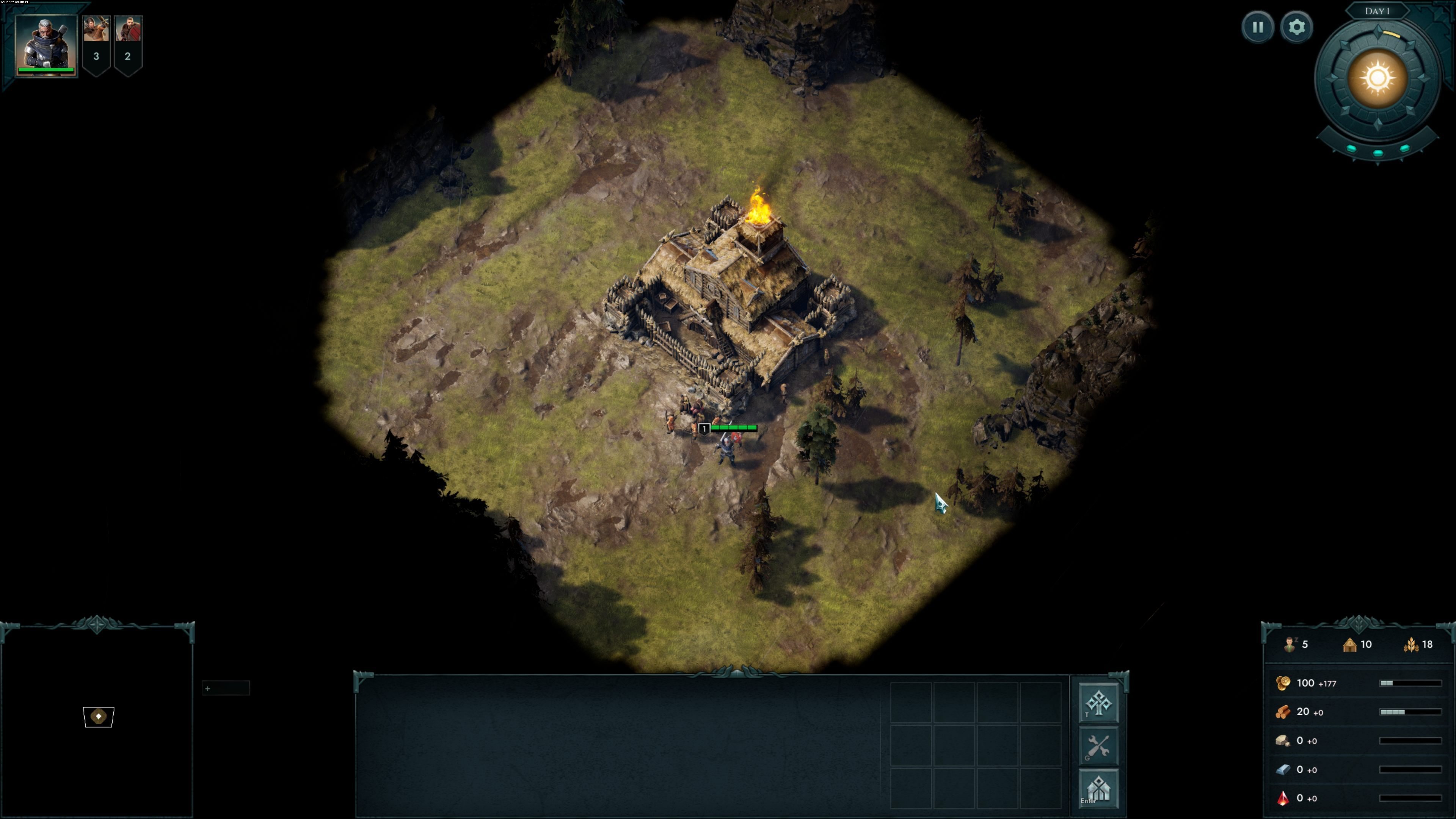
The beginnings are humble, but the empire will be eternal... or not.
What sets Age of Darkness apart from most other RTS games is the extremely hostile environment. As in They Are Billions, we have to fight for every piece of land, and natural bottlenecks present opportunities to set up fortifications and take a breather, if only for a moment. However, these moments of respite are, unfortunately, quite rare, because if we want to prepare for the next waves of enemies, we face a constant shortage of resources.
Alan Wake's Age of Darkness
However, the game is not a mindless carbon copy of They Are Billions and it does stand on its own legs (or rather: original ideas). The day-night mechanics prove to be of particular importance. During the day, the hordes of enemies are weaker and less eager to fight. So, this is a good time for initial boundary expansion. Night, on the other hand, makes enemies stronger and more brazen (hence the Alan Wake reference). Instinct tells you to hold on to your base and enhance walls. However, we must quickly abandon these thoughts if we want to survive – the rewards for exploration are better after dark, and we must also keep time in check, as the next wave is always on the move.
Every few days (the number increases with each wave of enemies), one of the crystals located on the map cracks. This occasions much fiercer attacks at night. If we feel we can make it, we can destroy the crystals ourselves. When I first accomplished this, I was hoping it would stop the attacks. I was wrong though, and it only sped up the raids and cut down on preparation time... I wasn't ready for this turn of events.
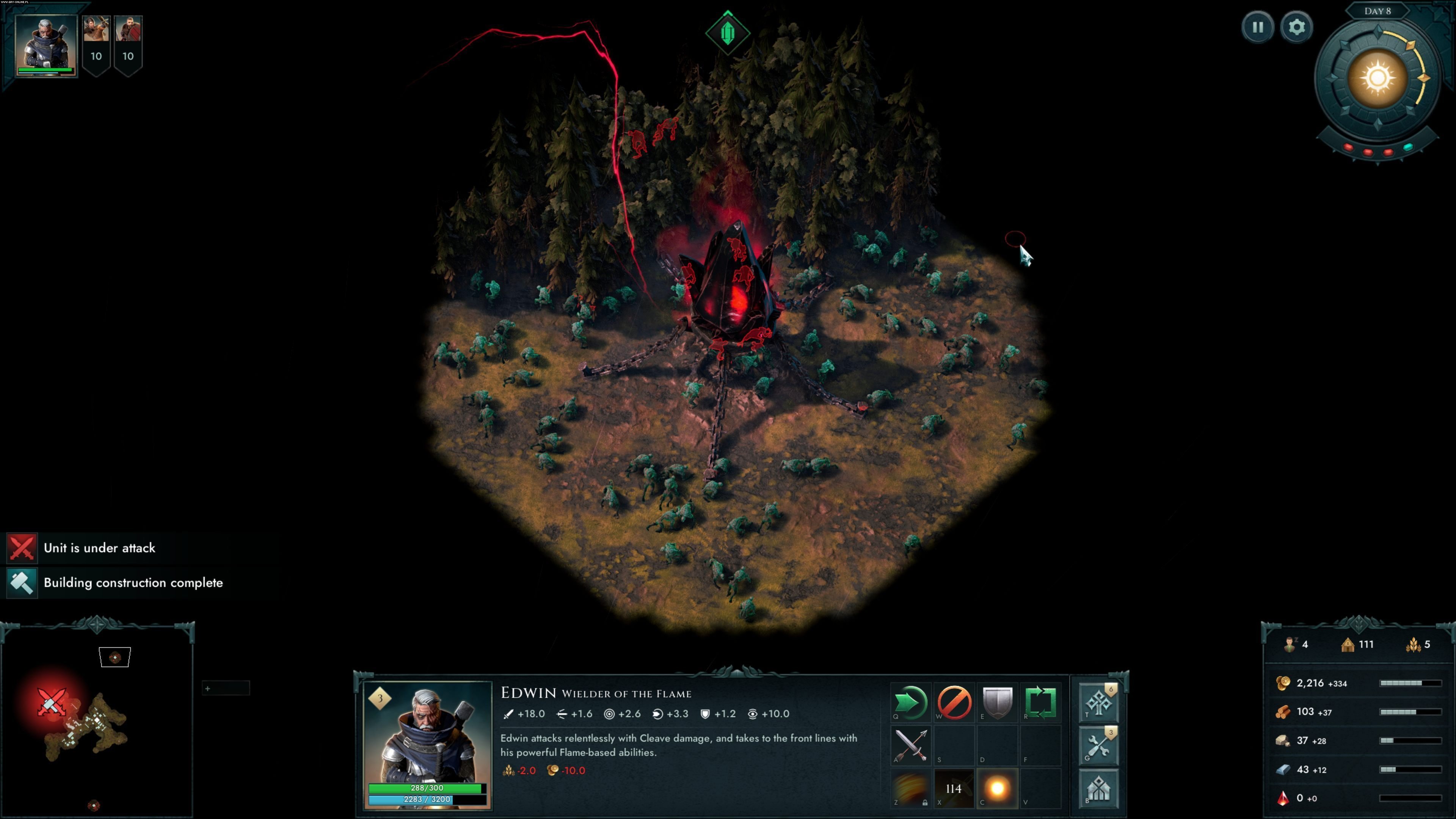
This piece of rock should be called the Stone of Impeding Doom.
During these attacks, it is not only the enemies that pose a threat – even the fog of war becomes dangerous. When our unit enters a dark space, it receives a debuff that slows down its movement and health regeneration (some enemies can also impose it). This can be cured with bonfires and the fortress. Light is friend!
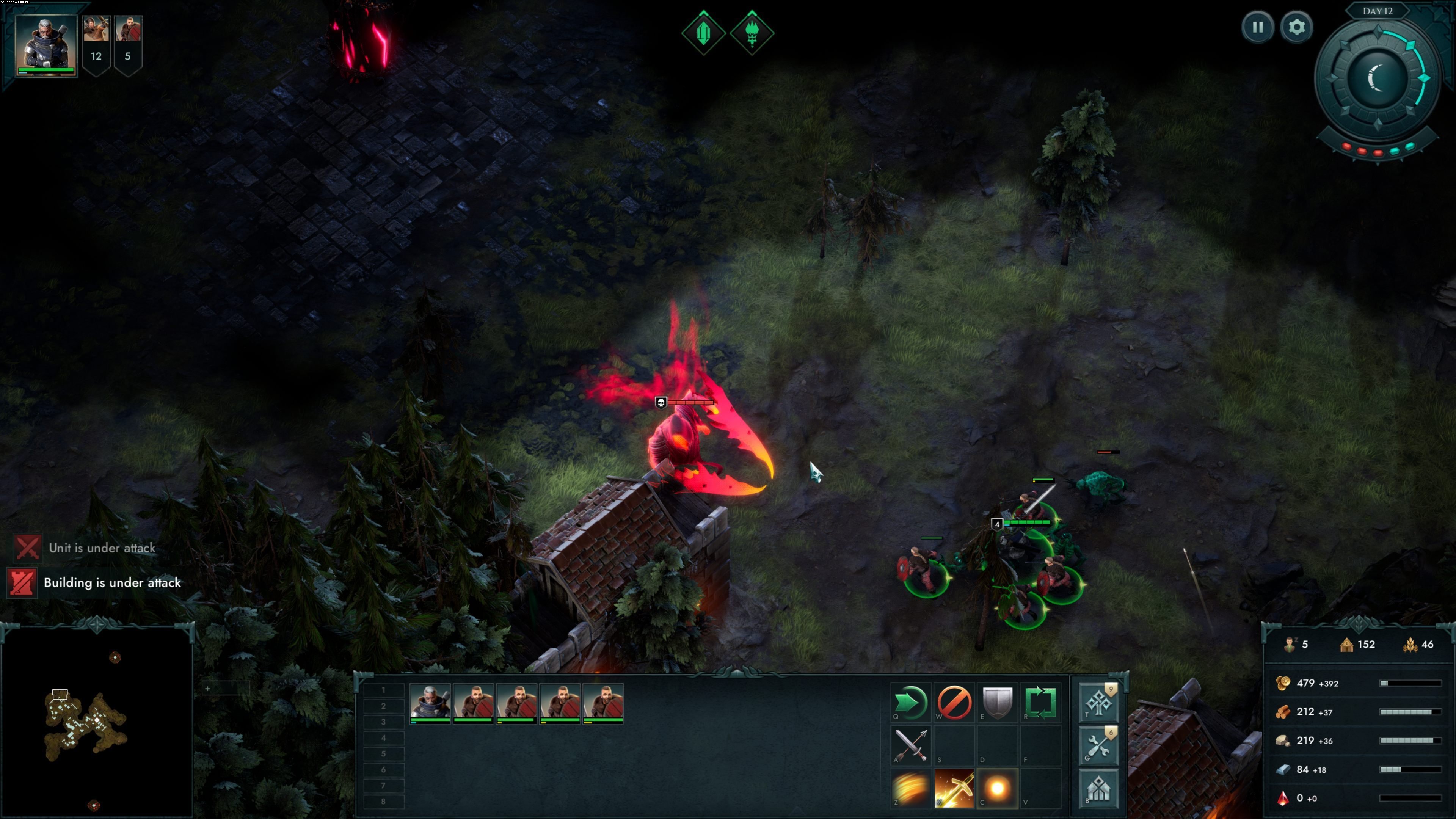
Suffice it to say that my unit was not ready for this meeting.
Minibosses also appear on the map at night. We will know the places where they materialize by the obelisks. These monsters are very strong and leave behind a special resource that allows us to buy upgrades for our soldiers. Be careful though – some of these creatures can be much more powerful than others. An army that has dealt with one creature without much trouble can be annihilated in a matter of moments by another.
Age of Dark Souls
The game has a high level of difficulty, which the developers inform you about right at the start. I went through it on "normal," but I didn't feel all that casual about it. Age of Darkness: Final Stand is not unforgiving and quickly starts throwing everything it has at the player.
My feelings towards this game are typical mix of love-hate. I really liked the idea of combining tower defense with RTS, and was happy to discover it's a happy marriage – I even hope that this game is paving a new way for the genre. The game has nice graphics and some unique mechanics, and despite early access, you can see that the foundation it's built on are solid. These foundations, however, are built on the dead armies of players.
Let's start with regular waves of opponents. The first attack is easy, with 149 monsters attacking us (the exact numbers are given at the top of the screen). It gives the illusion of security and suggests that things aren't so bad. The next skirmish turns out a bit harder – 599 enemies is an impressive increase, we can see where the enemies will come from, but the day before the fight, getting a chance to fortify the threatened section of the walls. However, on my first approach to the game, I did not expect the waves to grow at such a brutal rate – wave number 3 brought 1998 monsters. To say they went through my defense like a knife through butter is somewhat of an understatement. And then it only gets worse, with tens of thousands of different creatures eventually swarming our lone stronghold, aided by some huge bosses. Of course, I learned more and more of the game's intricacies with each approach, and the gameplay itself became easier in time, but it was easy to feel overwhelmed with it all.
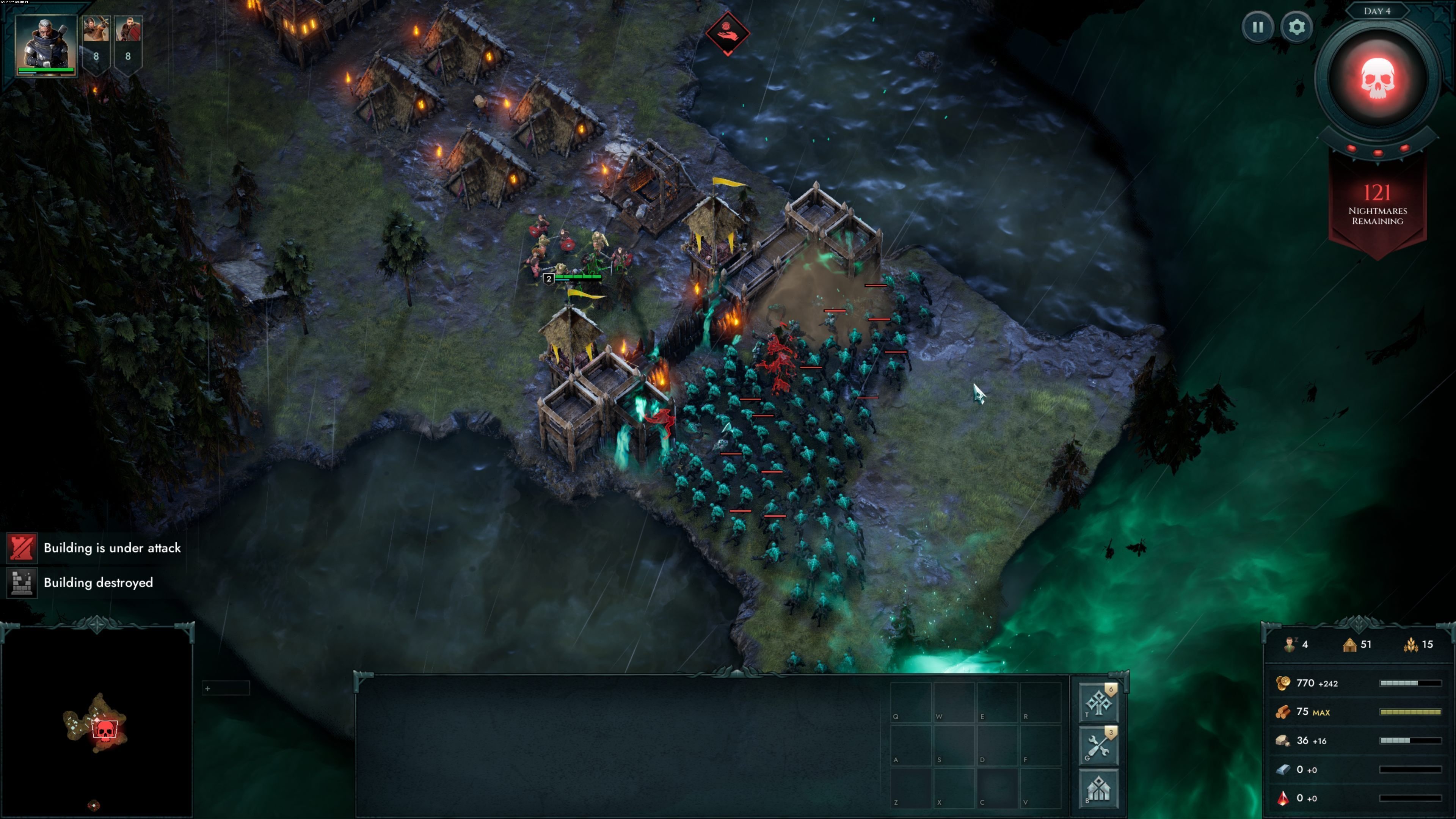
The first wave of enemies is tiny and easy to defeat. Don't be overconfident, though – I've made that mistake myself.
My first failure, however, was not solely due to lack of skill. It was mostly a matter of bad luck. Unfortunately, I didn't come across iron resources in time (except for one deposit, very meager at that), which obviously hampered the development of my economy and fortifications. This brings us to another aspect of the difficulty level – procedurally generated maps. The terrain that changes from game to game undoubtedly adds variety to the game. However, this carries an additional risk. For example, a powerful monster can be placed near a critical resource, you might find there's a shortage of iron in convenient vicinity of the village, or that gold is waiting in a location, from which it cannot be extracted. Unfortunately, we may already be doomed to failure before the first building is even erected.
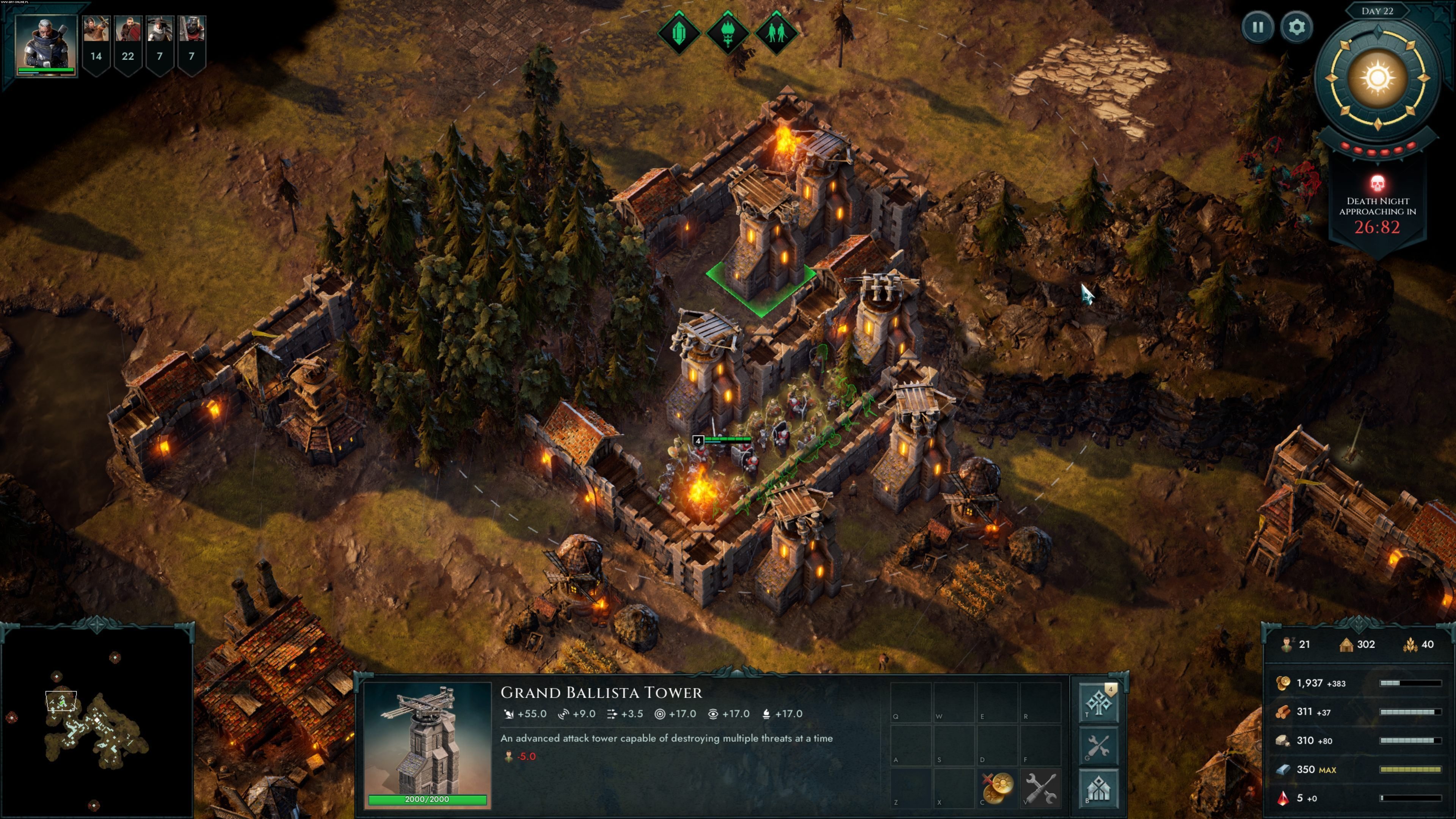
I survived 3 waves, I'll make it through the next one! As long as they attack here.
It's similar with the blessings we get for defeating waves of enemies. They provide our settlement and units with interesting bonuses. However, we never know which ones will be drawn. We can opt for any of the three effects proposed by the game, but they're offered randomly, so sometimes, we get a good plate with nothing on it.
Early Darkness
The game is currently available in Early Access, so turning a blind eye to some imperfections and shortcomings seems only natural. The developers promise to support it in the future, including the introduction of a story campaign. Personally, I would love to see some more buildings. I especially missed a marketplace that would allow to convert materials. At one point, I enjoyed a huge output of every raw material, and filled warehouses, but I had to wait until I earned enough gold. Exploring half of the map, I came across only two sources of gold – including one I couldn't use. This is a significant problem because tax revenue alone is not enough in the later stages of the game, when a single defensive tower costs 2000 pieces. Undoubtedly, additional units and siege engines wouldn't hurt the game either. Another aspect that could use more work are the procedurally-generated maps, which could use more balance.
Fortunately, those willing to try their hand at this game don't have to worry about the technical condition. Personally, I've only encountered occasional, minor flaws. Sometimes, the soldiers couldn't find their way among the buildings, a few times, a repaired structure was stuck in damaged state, or individual enemies got jammed in the woods to then surprisingly attack my buildings. The most annoying glitch was the hero's life bar displaying incorrect values when the character was selected along with other units. None of the bugs spoiled the game for me, though.
Age of Darkness: Final Stand
While waiting for the next Age of Empires installment, RTS fans, especially those, who enjoyed They Are Billions, can safely endulge in Age of Darkness, provided they have a knack for harder games. However, the emphasis is on that knack exactly. This game can really be exhausting. This title requires constant focus and planning ahead. As I mentioned before, there were many times when I felt the game was unfair, and I suspect I won't be alone in this impression. Additionally, it was released in Early Access, which in itself has unfortunately become somewhat of a red flag for many players. I, for one, am going to follow the development of this game and will certainly return in the future to see what it looks like.
ABOUT THE AUTHOR
I have a special place in my heart for strategy games. I've never counted how many of them I've played, but over the years, I've accumulated quite a few – turn-based, economic, RTS – all of them. I don't just focus on the classics, though. I am constantly looking for interesting productions that try to bring something new to the genre.
