Great Expectations and Great Turmoil - Star Citizen, and Its $95 Million
Star Citizen is a very promising project – after all, it raised $95 million in crowdfunding. What's the progress after so many years? Will the turbulence around the title affect the quality of the final product?
Crowdfunding is easily one of the best byproducts of the Internet. It gave us such games as Video Game High School (a great online series by Freddie Wong and RocketJump), the amazing RPG Pillars of Eternity, or the entire Shadowrun series. However, the money raised for the above games are nothing compared to the amount gathered for the purposes of the production of Star Citizen... allegedly. Now, 95 million dollars is over 2,000 pounds' worth of 100-dollar bills – how did they even manage that?
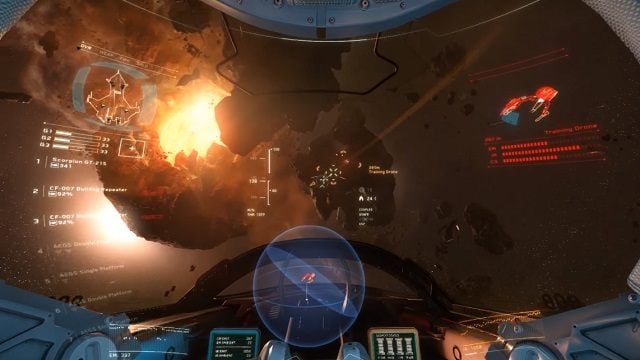
Let's go back to October 2012. Back then, a Kickstarter campaign of a certain space-game was launched, and it was spearheaded by none othere than Chris Roberts, the legendary creator of space simulators. The man had just returned to the world of video games, having released his last game back in 2003, and then being involved, i.a., in the film industry, where one of the movies he produced was severely delayed, and the production of which caused numerous legal battles in US courts. He planned to raise $500,000 for the game in one month, and he managed to amass $155k in the first twenty four hours. That's $6,500 every hour.
After achieving the main objective, we get to the heart of crowdfunding: money can be collected further – until the end of the campaign. The people running the campaigns can come up with different, additional objectives that they promise to deliver after achieving subsequent funding thresholds. And so, for $750,000, the donors unlocked the possibility of starting their adventure in Star Citizen with the AMX-1 repair drone. Subsequent goals included various types of spaceships to be available in the game. The whole campaign was an incredible success – over 2 million 130 thousand US dollars were collected from over thirty four thousand founders. Ok, but we're still 92 million 870 thousand short of 95M.
Apart from Kickstarter, the fundraising campaign was carried out – simultaneously – on the official Star Citizen website. The crowdfunding goals there were similar to Kickstarter, with ships, missions in the Squadron 42 mode, the ability to customize ship cockpits (from posters and framed pictures to had-bobbing figurines), professional mo-cap sessions for Squadron 42, additional star systems to explores, and an additional alien race. After achieving the threshold of $10 million, Cloud Imperium Games (the parent company managing this project) declared that it would build its own studio for motion capture sessions, as well as use face animation recording technology similar to that from LA Noire.
Later, the founders also paid for the development of three alien languages from scratch (sic), the ability to travel with their own pet on board a spaceship, and professional voice acting by such household names as Gary Oldman and Mark Hamill. The last recorded threshold that guaranteed the community additional bonuses was $65 million, and we can only guess whether that was due to lack of ideas of the creators, or rather their prudence in planning the workflow, supported with concerns as to their abilities to actually deliver all their promises within a reasonable time frame.
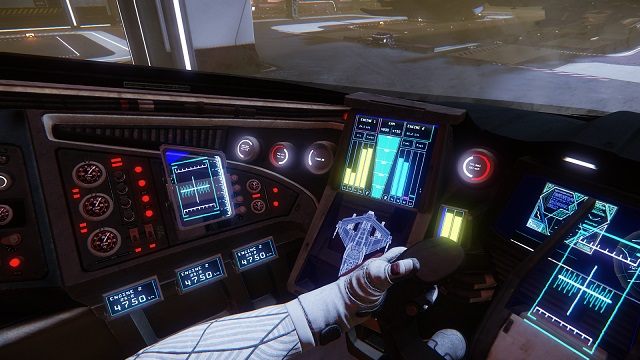
There were many ideas about how Star Citizen should ultimately look like during the last three years. As long as the game is indeed released, we will get a regular, single-player campaign entitled Squadron 42, in which we will have to complete a number of missions, such as, for example, protecting the borders against the warlike hordes of the Vanduul. After we complete our service in the squadron, we will get a civilian ship. This will be the ticket to the MMO mode, which will give us control over our fate – we will join the ranks of a trade company, a pirate fleet, a group of explorers, or a brigade of head hunters. The creators stated that "where one conflict ends, the next one begins just around the corner," and we will be given full freedom in creating gameplay, without a moment of boredom.
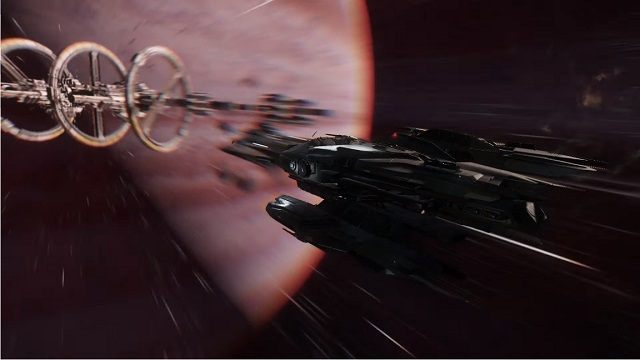
The online portion of Star Citizen is where most of the game's attractions and possibilities will be found, which Roberts himself described on one occasion as "as vast as outer space" – and which are intended to redefine the idea of sandbox. For example – if we discover a new planetary system, we will not only get a big money reward, but also be able to name the given celestial body! Cloud Imperium Games makes sure that players also take active part in building the entire universe. Cooperation between ought to be an important element of the game, also when handling a ship – we should be able to travel the galaxy with friends on board the same, powerful vessel, experiencing galactic adventures together, taking shifts behind the helm and manning the cannons. The damage system will provide a great depth to space battles, as it should be able to generate thoroughly detailed destruction of the ship and its individual elements. All of this will obviously affect the maneuverability and defense of our ship.
The level of detail is another thing that made an amazing impression already in 2012 and still does it (the game has since switched to an upgraded graphics engine). The 2013 AAA mega-productions typically used 10,000 polygons for rendering characters and around 30,000 for vehicles. Roberts must have been really determined to obliterate that score, increasing both figures by a factor of around 10. The greater detail of the objects is to evoke an even more powerful feeling of immersion – a word that Roberts seems to be obsessed with.
In addition, our spaceships are to be built of about 100 interactive segments that have a real impact on the flight – we will no longer encounter textures of buttons and controls that only look as if they did something, but do not fulfill any function (except aesthetic). The developers also provide full support for the Oculus Rift goggles, if anyone would like to feel as if they were actually sitting in the cockpit of a spacecraft. Is that not enough?
The devs certainly aren't afraid to make big promises, and that's why many players find it increasingly difficult to believe that the project will ever be carried out according to such visions. CIG has not released Squadron 42 so far, and not even a single piece of information about the possible release date of this module has been announced. So, it is 12 months late by now. The Escapist also doubts the credibility of a successful completion of the production.
Editor Lizzy Finnegan contacted nine former employees of Roberts Space Industries, who and they really railed at Roberts and RSI. The first anonymous claim brought against Star Citizen's creator was his alleged mismanagement – most of the money raised was to be squandered for private purposes by Roberts himself and his wife. In addition, informants complained about the terrible atmosphere at work, described as toxic, and frequent mobbing – employees were allegedly insulted with obscene epithets. Many of Finnegan's interviewees also claimed that Roberts could not take any sort of opposition, and that he vented his frustration on subordinates.
Chris Roberts categorically denies all these claims coming from by nine former RSI employees, and he even sent an e-mail to The Escapist (which, by the way, ended up in the spam of Finnegan's supervisor...), in which he invites journalists to all of his four studios developing Star Citizen to examine the situation. Was that a bluff? Or maybe the claims were false, after all, and the atmosphere in the studios is indeed good?

Then, there's also a thread of Derek Smart, another developer who – to put it mildly – does see eye-to-eye with Chris Roberts. Why does Smart feel such an aversion to Star Citizen and its creator? Well, in 2014, he released the early access of his space MMO – Line of Defense – but it was not a game that could technologically or graphically challenge Star Citizen even in its earliest versions from 2012. Smart was also under flak from Steam users – only 17% of reviews of his game were positive. Was that reason enough for him to launch a smear campaign against RSI, effectively putting himself in the shoes of David standing in front of Goliath?
Let's take a brief look at social media – Star Citizen's Facebook and Twitter profiles are very active: the creators regularly communicate with the community. There are also systematic shows of the game, such as CitizenCon 2015, which took place on October 10 – if I wanted to embezzle money, I would run away with the money collected on the Kickstarter alone, rather than invest it into advertising a product that does not really exist. In addition, in the description of the kickstarter campaign (before the fundraising event), Roberts assured he had the bare minimum of capital necessary to create a basic version of this game, but that he wanted to make it something much bigger with the help of community. So, why are there accusations about blowing the funds and questions about the possibility of the game's completion if the funding was there all along, even before Kickstarter? Would CIG just lie to the founders at the start by stating they had the money secured, and wanted to extort veritable millions of dollars just so that Roberts could drink margaritas in the Cannary Islands or whatever? Well, someone has to be lying – it's either Roberts, or former employees dissatisfied with their dismissal – so far, there is not enough hard evidence, or even circumstantial evidence, for that matter, that would let us determine who's doing the foul play. We can only guess and try to decide who's statements make more sense.
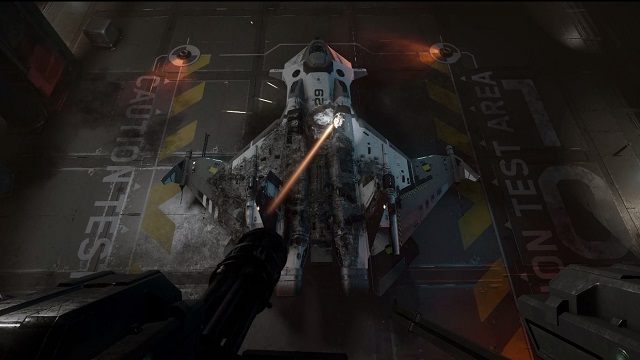
The gaming world has seen many great visionaries before Roberts who wanted to change the industry, and were devoured by their own ambitions and sanctimoniousness – just to mention Peter Molyneux, the father of Fable, and possibly the bosses of EA Dice. However, I still am inclined to believe that Roberts has not been idling out during the twelve years and that, contrary to the reports of former employees, he knows how to bring this story to a happy and fair conclusion. Star Citizen is a hugee challenge, and there's a fine line separating the hit of a decade from an unforgivable failure. Not only the reputation of Cloud Imperium Games is at stake, but also the future of crowdfunding – if Roberts fails, the trust in such campaigns will take a big hit – as big as a heap of 95 million dollars.